Physical Address
304 North Cardinal St.
Dorchester Center, MA 02124
Physical Address
304 North Cardinal St.
Dorchester Center, MA 02124


Investing can be very similar to weather forecasting, and if the weather forecast is not favorable and you decide to go to the park with an open parachute, the outcome is pretty obvious. However, on the same note, it might turn out that tomorrow you wake up to sunny skies and the stock market is growing again – just as much as my motivation for going to the gym decreases when it rains. And exactly this unpredictability makes the all weather portfolio the perfect solution for any investor.
The idea first got popularized by one of the most successful investors in the history of the finance industry – Ray Dalio, founder of one of the world’s largest hedge funds. His motto was quite simple yet very effective – don’t try to predict how the future will play out, try to prepare yourself for everything that may happen. Inflations, recessions, interest rates, growth – none of that should affect you if you have prepared properly and created an all weather portfolio. When I started learning more about investing, I quickly understood that prediction is useless.
This is why the strategy is popular because it emphasizes balance rather than speculative behavior. Unlike putting your money entirely in stocks in the hopes that everything will be okay, an all-weather portfolio will allocate funds among several asset classes in order to achieve stability.
The concept is rather straightforward. Some assets tend to do well in one type of economic environment, while others excel in another type of economy. Stocks tend to do well during economic expansion. Bonds will do better during recessions. Commodities can thrive during times of inflation, and some alternative assets can provide protection during uncertain times.
Think about it like a professional sports team. When every single player has the same set of skills, the whole team can fall victim to the situation at hand. But, with each player bringing his unique strength to the table, there will always be something the team will be able to do no matter what.
At the start of my journey in investments, I too fell into the trap of being overly focused on returns and neglecting everything else. With experience, however, I realized that safeguarding investments through tough times is just as crucial as earning profits during good times. This philosophy forms the basis of the all weather portfolio since it recognizes the certainty of economic cycles.
There is one word that can best be used to describe the all-weather portfolio: diversification. In layman’s terms, diversification refers to the spread of investments across many different assets and geographic areas. The objective is not necessarily profit maximization but rather reduced risk and consistent growth in the long run.
The mistake that investors frequently make is that they allocate too much money to a particular type of asset. I have personally observed some people making large investments in stocks, industries, and cryptocurrencies hoping that they will become rich soon enough. It sometimes happens, but more often than not, it increases risks to an investor. Diversification becomes essential in such cases as a precaution against any negative events.
Consider diversification to be similar to planning a road trip where you cannot just depend on a single tyre, a single map, or a single source of fuel. With more options, there will be a higher probability of reaching your destination. This principle applies to the process of diversification which ensures that your journey as an investor continues even amid uncertainties.

Over time, the market has had experiences of uncertainties whereby the economy faces economic slowdowns, financial crisis, geopolitical unrests, or inflation shocks. Through diversification, you can mitigate such occurrences by ensuring that some investments are not adversely affected while others are performing optimally.
When asked what determines successful investing, the common answer received is stock picking. Interestingly, research has shown that more importance should be placed on asset allocation than stock selection.
The term ‘asset allocation’ refers to the manner through which you invest across the various asset classes. Such classes include equities, bonds, commodities, and cash, to name just a few. The purpose of allocating your investments across different types of assets is to strike a balance that will help achieve the investor’s needs for risk aversion and time frame. Typically, a good all-weather investment will comprise multiple asset classes since the various types of assets tend to react differently to changing economics.
For instance, when the economy is doing great, it might be wise to invest in equities. When in recession, the best place to put your money might be government bonds. In times of high inflation, commodities and precious metals should be considered.
To make a comparison, I prefer to imagine the role played by asset allocation as that played by the foundation of a building. No matter how well furnished the building is, if the foundation is not sound, the whole thing will come crumbling down. That is the case with investments.
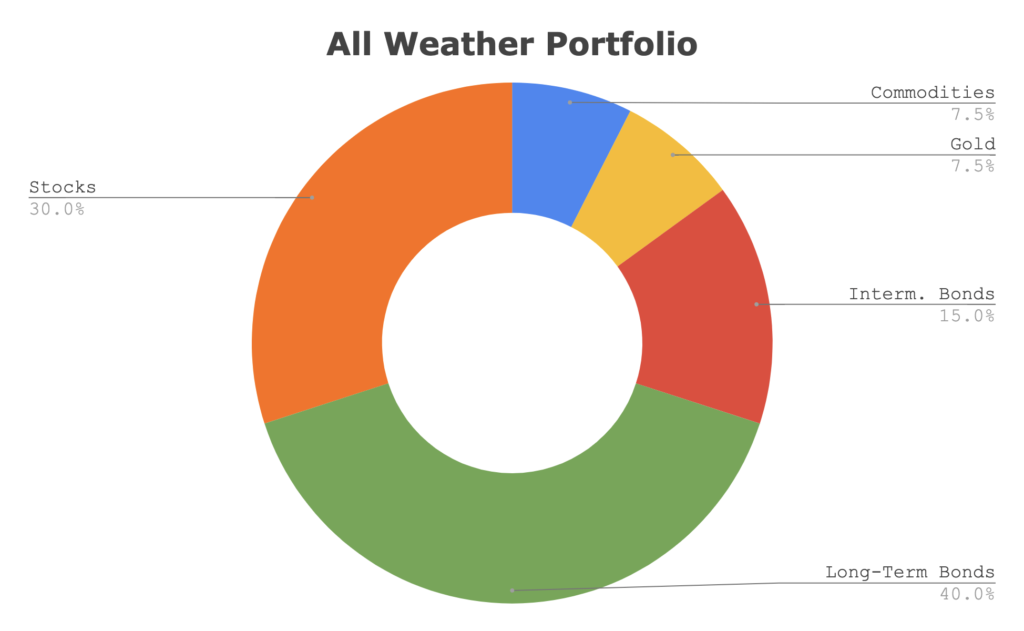
These might include:
As always, the percentage will depend on the investor’s goals. Some will have a more growth-focused portfolio, while others will concentrate on capital protection. What makes an all-weather portfolio so attractive is its customizability. The allocation is flexible and can be adapted without breaking away from its basic premises.
The thing that I like most about this approach is that it is not based on looking for the latest fad investment to add to one’s portfolio. On the contrary, it is all about balancing various investments.
Building a profitable investment portfolio takes some time. One of the key misunderstandings among inexperienced investors is thinking that profits come overnight. Unfortunately, the financial markets do not work the same way as a vending machine. After depositing your money in, you won’t be able to withdraw your earnings immediately.
The all-weather portfolio is designed with long-term investing in mind. This portfolio is not intended to beat every asset across every market cycle.
I also have to keep reminding myself that investments are just like the act of planting a tree. You can never be able to dig up the tree every week to ensure that its roots are growing. Doing so will not even help in growing the tree but instead will hinder its growth. Investments take time and need patience to grow fully.
The all-weather investment philosophy ensures that investors think of the larger picture. Investors often become too concerned about the small things happening in the markets every day.

The most overlooked part of investments is how they are aligned with finances. Your investments should be geared towards a particular objective and should not be made just because you feel like investing.
There are various crucial questions that one needs to ask themselves before starting to create an all-weather portfolio. Are you saving for retirement? A house for the future? For your children’s education? To achieve financial independence?
Financial objectives need different strategies. An individual making an investment plan twenty years before his/her retirement will focus on stabilizing the plan. Another person who intends to buy a home after three years will take more risk. The all weather portfolio can always be tailored to meet various objectives.
When financial objectives determine how you invest, it is easier to stick to the plan even when the markets fluctuate because there is a reason behind each investment.

An all-weather portfolio is subject to rebalancing at times. The act of rebalancing entails restoring the portfolio to its original asset allocation. Some investments tend to outperform other assets over time leading to changes in the composition of your investment portfolio.
For instance, after some gains in stock investment, your stocks may make up a higher portion of your overall portfolio than expected.
In my view, rebalancing should be viewed through the prism of gardening. The lack of constant care will lead to the excessive growth of some plant species and the absence of others. In other words, rebalancing helps avoid having one dominant investment that might increase your risks.
Most investors are not required to rebalance their investments all the time. Their mission is to exercise control over themselves in order to stay away from panic.
The strategy itself seems quite simple; however, investors can still do something wrong. For example, there are those who decide to abandon the idea of a portfolio due to its poor performance in bad times. Nevertheless, it is exactly these moments when diversification pays off the most.
Another error refers to an excessive focus on profitability and changing the whole idea every single day. As I mentioned before, the all weather portfolio was intended to help you stop guessing and predicting.
Patience seems to be underestimated as well since sometimes your portfolio won’t give you outstanding results compared to aggressive approaches during good times. However, this very quality will pay off during bad economic times.
Consistency is key in successful investing. The investors who tend to get the most out of their all-weather portfolios are the ones who are disciplined and committed to the strategy throughout many years of trading.
The all weather portfolio is not an elixir that helps generate extraordinary profits for you. However, what it promises is something even more valuable – resilience. Thanks to diversification, proper asset allocation, and correlation with your financial goals, the all weather portfolio aims to achieve stability in any economic climate.
One of the best things that the all-weather portfolio gives me is peace of mind. As I am no longer obsessed with the latest economic data and predictions, my focus goes into building and sustaining my diversified investment portfolio, which is prepared to withstand different economic situations.
If you need a disciplined way of accumulating capital, the all weather portfolio strategy should definitely be considered by you. Although not the most entertaining approach, as any seasoned investor knows, boring and consistent is what usually wins at long-term investing.
| Step | Action | Why It Matters |
|---|
| 1 | Define your financial goals | Determines risk tolerance and investment horizon |
| 2 | Build an emergency fund | Prevents forced selling during emergencies |
| 3 | Learn basic asset allocation principles | Creates a balanced investment foundation |
| 4 | Invest in diversified stock funds | Provides exposure to economic growth |
| 5 | Add government bonds | Improves stability and downside protection |
| 6 | Include inflation hedges such as gold or commodities | Helps protect purchasing power |
| 7 | Rebalance annually | Maintains desired allocation |
| 8 | Continue investing regularly | Benefits from long-term compounding |
| 9 | Avoid emotional decisions | Supports long-term performance |
| 10 | Review financial goals annually | Keeps the portfolio aligned with life changes |
One of the most basic things that I’ve come to understand throughout my life is that no one really knows how the markets will behave tomorrow. It is not always the brightest of the investors who make the most predictions, but rather those who plan the best. This is what the all weather approach does.
An all weather portfolio is an investment strategy designed to perform reasonably well in different economic conditions, including periods of growth, recession, inflation, and market uncertainty. Instead of relying heavily on one asset class, it combines stocks, bonds, commodities, and other investments to create balance and stability. The goal is not to achieve the highest possible return every year but to reduce risk and provide more consistent long-term performance.
Diversification is the foundation of an all weather portfolio because it spreads risk across multiple asset classes. When one investment performs poorly, another may perform better and help offset losses. This reduces the impact of market volatility and can make the overall investing experience less stressful. Diversification helps investors avoid putting all their financial hopes into a single investment or market sector.
Asset allocation determines how your investments are distributed among different asset categories, such as stocks, bonds, commodities, and cash. It is one of the most important factors influencing long-term investment performance. A well-balanced asset allocation helps manage risk while providing opportunities for growth. The right allocation depends on your age, risk tolerance, investment timeline, and financial objectives.
Yes, an all weather portfolio can be an excellent choice for beginners because it focuses on long-term stability rather than short-term speculation. New investors often struggle with market volatility, and this strategy helps reduce emotional decision-making by spreading investments across multiple asset classes. It also teaches important investing principles such as diversification, discipline, and patience.
Most investors review and rebalance their portfolio once or twice a year. Rebalancing ensures that your original asset allocation remains intact as market movements can cause certain investments to grow faster than others. Regular rebalancing helps maintain the desired risk level and keeps your portfolio aligned with your long-term investment strategy.
No investment strategy can completely eliminate losses during a market downturn. However, an all weather portfolio is specifically designed to reduce the impact of market crashes through diversification and balanced asset allocation. While stocks may decline during difficult periods, bonds, gold, or other defensive assets may help cushion the overall portfolio and improve recovery potential.
A typical all weather portfolio may include:
The exact mix depends on an investor’s financial goals, risk tolerance, and investment timeline.
You do not need a large amount of money to get started. Many investors begin with small monthly contributions through mutual funds, ETFs, or investment platforms that offer fractional investing. The key is consistency rather than the initial amount. Even modest investments can grow significantly over time through compounding and disciplined investing.
The answer depends on your goals and risk tolerance. A stock-only investing portfolio may generate higher returns during strong bull markets, but it can also experience larger losses during downturns. An all weather portfolio prioritizes balance and risk management, making it attractive for investors who value stability and long-term consistency over maximum short-term gains.
The best way to determine suitability is to evaluate your investment objectives, risk tolerance, and time horizon. If your priority is building long-term wealth while reducing the impact of market volatility, an all weather portfolio may be a strong fit. Investors seeking a disciplined approach that supports multiple financial goals often find this strategy particularly appealing because it focuses on resilience across changing economic environments.

Share your details, and we will get back to you shortly!
This will close in 0 seconds
Share your details, and we will get back to you shortly!
This will close in 0 seconds






[…] 7 Powerful All Weather Portfolio Secrets That Can Transform Your Financial Future […]
[…] 7 Powerful All Weather Portfolio Secrets That Can Transform Your Financial Future […]