Physical Address
304 North Cardinal St.
Dorchester Center, MA 02124
Physical Address
304 North Cardinal St.
Dorchester Center, MA 02124


An investment club is essentially a group of people who come together to learn about investing, research opportunities and, in many traditional arrangements, pool money to make investments collectively. The concept is hardly new, but the way people participate has changed dramatically. According to the SEC’s Investor.gov guidance, traditional clubs generally study investments together and make decisions collectively, sometimes through member voting, while another model allows members to research investments together but invest separately.
That distinction matters because when I hear the phrase “investment club,” I might imagine ten friends sitting around a dining table arguing about whether Apple or Microsoft is the better buy, but today the same learning experience can happen through online communities, subscription services, virtual meetings and self-directed groups. The basic idea, however, remains surprisingly simple: learn together, challenge each other and make more informed decisions.
The best clubs aren’t supposed to be magical money machines; they are more like a financial gym where members build better habits through repetition, discussion and accountability. And just like going to the gym, simply having a membership does not automatically give me six-pack abs—or a six-figure portfolio.
The real value of an investment club can be found in the quality of the decision-making process rather than the promise of spectacular returns. When I invest alone, it is incredibly easy to fall in love with a stock because I like the company, its CEO, its products or the latest headline appearing on my phone. A club can introduce different perspectives that force me to defend my reasoning instead of simply following my emotions.
One member might examine valuation, another might study financial statements, another might focus on industry trends, while someone else asks the uncomfortable question everyone else forgot: “What happens if we’re completely wrong?” That kind of discussion can be incredibly valuable.
The SEC also warns that clubs are not automatically subject to one universal regulatory treatment; the structure and activities of each club matter, particularly when passive members or pooled investments are involved. So, before joining one, I should look beyond a flashy name and understand exactly what the club does, how decisions are made and where my money would actually go.
A traditional investment club usually has members contribute money periodically, discuss potential investments and vote on what the group should buy or sell. The club may maintain a brokerage account in its own name, keep records of each member’s contributions and calculate everyone’s ownership interest. Some groups meet monthly, while others operate primarily online.
The educational side can be just as important as the money itself because members learn by actually researching businesses and explaining their conclusions to other people. The SEC describes this participatory model as one where members actively help make investment decisions. That active participation is important because a club can become legally and structurally different when one person makes all the decisions while everyone else simply contributes cash. In other words, an investment club should not quietly turn into “Give Bob your money and hope Bob had coffee this morning.”
One of the strongest reasons to join an investment club is education. I don’t need to be a Wall Street analyst to start learning about stocks, but I do need a willingness to ask questions, read financial information and admit when I don’t understand something. A good club gives me a reason to keep learning because other members expect me to contribute. Instead of casually watching a YouTube video about investing and forgetting everything ten minutes later, I may have to present an actual company analysis at the next meeting.
That creates accountability. It also exposes me to investing styles that may differ from my own, which can be useful when markets become emotional. The group environment can help turn investing from a guessing game into a repeatable process based on research, debate and risk management.
There is another advantage that often gets overlooked: behavioral discipline. Markets can make intelligent people behave strangely. A stock rises 20%, and suddenly everyone feels like Warren Buffett; the same stock falls 20%, and everyone starts googling “how to become a millionaire without investing.” A thoughtful club can slow down that emotional cycle.
Members can revisit the original investment thesis, examine new information and decide whether the fundamentals actually changed. That doesn’t mean a group is automatically smarter than an individual. Groupthink is a real danger, and five people agreeing with one another doesn’t magically transform a bad idea into a good one. The objective should be constructive disagreement, not a financial popularity contest.

An effective club can divide research responsibilities without dividing responsibility for the final decision. One member might investigate revenue growth, another could examine debt, another could study competitors and another could analyze valuation. I might learn more from explaining my own research to four skeptical people than from reading ten generic investing articles.
The process also teaches practical skills such as interpreting financial statements, comparing businesses, understanding risk and separating a company’s story from its numbers. These skills can remain useful even if I eventually leave the club and manage my own portfolio. The most valuable return from a club may therefore be the knowledge members carry away rather than the performance of a single stock.
Generally, there is no universal rule saying that someone must be wealthy, professionally employed in finance or already experienced to participate in an investment club. Clubs can establish their own membership requirements, contribution levels, meeting schedules and investment philosophies. Some are designed for beginners, while others attract experienced investors who want to debate individual companies or particular strategies. Online investment communities can also make participation easier for people who don’t live in the same city as other members.
However, joining a club is different from handing money to someone who promises to invest it for me. The structure matters, and I should understand whether I am joining an educational community, a self-directed group, a pooled investment partnership or a paid investment-information service.
This distinction becomes especially important when considering regulation. The SEC explains that if all members of a traditional investment club actively participate in investment decisions, the membership interests may not be treated as securities under the Investment Company Act in the same way as they might when passive members are involved.
That doesn’t mean every club is automatically exempt from every securities law or state requirement. It means I should avoid assuming that the words “investment club” provide some kind of legal force field. If money is being pooled, securities are being purchased and one person is effectively controlling the portfolio, professional legal and tax advice may be appropriate.

The best investment club isn’t necessarily the one boasting the highest historical return. In fact, that may be one of the first things that makes me suspicious. A strong club should be transparent about its strategy, risks, fees, decision-making process and historical performance. Members should know how much money is being contributed, who has authority over the account, how withdrawals work and what happens if someone wants to leave. There should also be written rules rather than relying on everyone’s memory after a meeting involving pizza, coffee and three contradictory opinions about Tesla. A good club understands that trust is built through systems, not handshakes.
I would also look closely at how disagreements are handled. If the club leader dismisses questions, guarantees profits or pressures members to invest immediately, that’s a serious warning sign. A healthy club should welcome skepticism because investing involves uncertainty. Members should be encouraged to ask what could go wrong, not just what could go right.
This is particularly relevant in today’s environment, where social media can make financial advice appear more authoritative than it actually is. The Wall Street Journal recently highlighted concerns around financial advice on social platforms, noting that investors can encounter everything from sensible long-term strategies to risky stock picks and potentially misleading claims. A good investment club should teach me how to think, not simply tell me what to buy.
One of the most recognizable modern examples is the CNBC Investing Club, associated with Jim Cramer. But this is where terminology can become confusing. The CNBC Investing Club is a premium subscription service, not a traditional pooled-money investment club where subscribers collectively own a portfolio. CNBC’s current description says the service gives subscribers a real-time view into Jim Cramer’s Charitable Trust holdings, along with newsletters, articles, live calls and market analysis. That makes it closer to an investment education and information service than the traditional investment-club model described by the SEC.
The distinction is important because someone searching for a “Cramer investment club” might assume that joining the service means becoming a partner in Cramer’s portfolio. It doesn’t. CNBC says the Investing Club is now the official home of Jim Cramer’s Charitable Trust, and subscribers can see portfolio moves and receive market insights. The current service also includes features such as the Morning Meeting, newsletters and other educational content. In other words, I can participate as a subscriber and learn from the discussions, but I am not handing CNBC a pile of cash to be combined with everyone else’s money into one member-owned investment club.
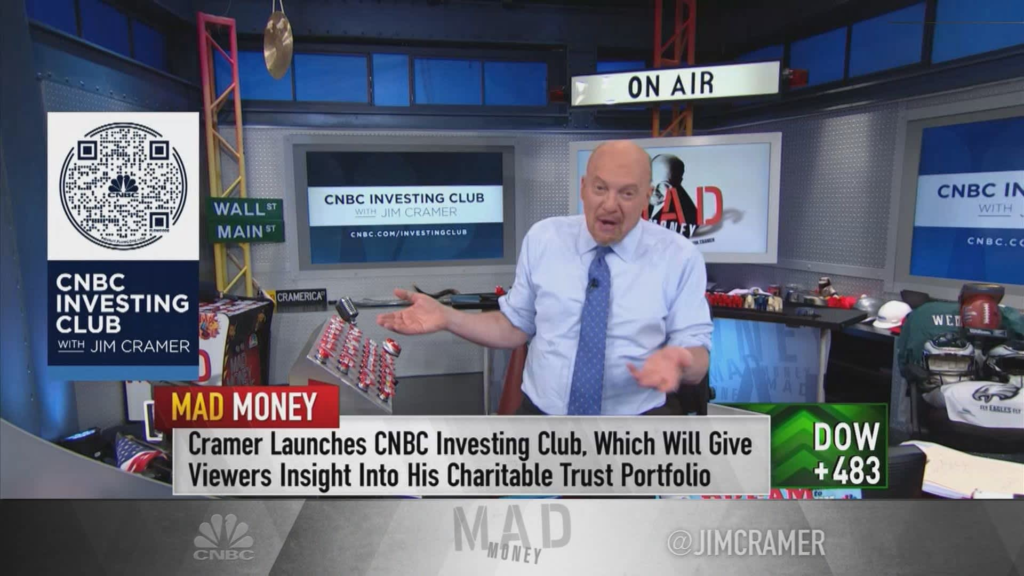
The phrase Cramer investment club is useful for understanding how the term has evolved online. People increasingly use “investment club” to describe communities, subscription services and educational platforms where investors follow professional analysis rather than physically pooling their money. Cramer’s service is a prominent example of that shift.
It offers access to a portfolio, commentary and decision-making context, but subscribers remain responsible for their own investment decisions. The current CNBC help documentation describes the service as providing access to the Charitable Trust portfolio and Cramer’s broader market analysis, rather than presenting it as a conventional partnership. That difference should be clear to anyone researching the best investment club in the USA.
No, not in the traditional legal and structural sense. A conventional investment club generally involves members who actively make decisions together and may pool their money. CNBC Investing Club, by contrast, is a subscription product centered around Jim Cramer’s Charitable Trust and investment commentary.
CNBC’s current materials explicitly describe it as a premium service, and its relationship with the Charitable Trust is central to the product. This makes it potentially useful for investors who want a window into a professional market commentary process, but it shouldn’t be confused with a neighborhood investment partnership where ten people each contribute $100 every month.
That distinction also answers a common question: Can I be part of it? Yes, I can subscribe to CNBC Investing Club if I want its content and features, but participating in the service doesn’t make me a co-owner of Jim Cramer’s Charitable Trust.
CNBC currently lists the Investing Club as a separate subscription from CNBC Pro, with its own benefits and pricing structure. That means I should evaluate it like any other paid financial-information service: consider the cost, understand what I receive and decide whether the information actually improves my own process. Following someone else’s trades without understanding the reasoning is not investing education; it’s just expensive button-clicking.
Castlelake is another name that can appear in investment-related research, but it should not be confused with a traditional investment club. Castlelake describes itself as a global alternative investment firm specializing in asset-based private credit, with approximately $38 billion in assets under management. Its activities illustrate a very different corner of the investment universe from a small group of friends buying public stocks. Castlelake has recently been active in areas such as residential lending and private credit, including a 2026 transaction involving Eastview and Lendmarq that expanded its U.S. residential lending capabilities.
Why does that matter to someone researching an investment club? Because it demonstrates how broad the word “investing” really is. A beginner might think investing means buying shares of companies listed on the stock market, while professional firms may invest through credit, loans, mortgages and other asset-backed opportunities.
Castlelake and Redwood Trust also announced a strategic joint venture in April 2026 that contemplates purchasing up to $8 billion of prime jumbo mortgage loans. A small investment club probably isn’t going to replicate that operation—and it shouldn’t try. The lesson is simply that investors need to understand the asset class, liquidity, risk and expertise required before chasing sophisticated strategies because they sound impressive.

The phrase Wall Street often makes investing sound like an exclusive club filled with expensive suits, giant screens and people shouting into phones. In reality, many of the principles professional investors use can be adapted by ordinary investment clubs.
Research the business, understand its competitive position, evaluate management, examine financial statements, consider valuation and identify what could permanently impair the investment. A club doesn’t need a Wall Street-sized bank account to adopt Wall Street-style discipline. In fact, a small group with strong research habits can sometimes be more focused because it doesn’t have a huge organization slowing everything down.
The most important lesson is probably process. Professional investors don’t simply ask, “Will this stock go up next week?” They often ask questions about the business model, cash flows, valuation, catalysts, downside risk and the probability of different outcomes.
An investment club can use the same framework. Before buying anything, members can write down the investment thesis, identify the reasons it might fail and establish what information would cause them to change their minds. That approach makes the group less vulnerable to hype. It also creates a historical record of decisions, allowing members to look back later and discover whether their reasoning was genuinely good or whether they simply got lucky.
One of the biggest misconceptions about Wall Street is that successful investing is about discovering the next hot stock before everyone else. In practice, professional investing can involve portfolio construction, position sizing, risk management, liquidity analysis, valuation and constant reassessment. Even sophisticated firms can get investments wrong.
Current reporting on private-market investing also highlights concerns around fees, liquidity, valuations and complexity, showing why investors should not assume that a more sophisticated product automatically means a better investment.
An investment club can take that lesson seriously by focusing on risk before return. If a club puts half its portfolio into one speculative company because everyone is excited about it, the members may discover that diversification was not merely a boring textbook concept. The goal isn’t to eliminate risk—because that is impossible—but to understand it. A club that survives several market cycles while steadily improving its decision-making process can be far more valuable than one that enjoys a spectacular return during one lucky year.
The first major mistake is allowing one person to become the unofficial investment dictator. If everyone contributes money but one member makes every decision, the group may no longer resemble the active-participation structure that defines many traditional investment clubs. The second mistake is failing to establish written rules. Members should know how contributions work, how votes are counted, how profits and losses are allocated, how records are maintained and how someone can leave. The third mistake is ignoring taxes and compliance because “we’re just friends.” Friendship is wonderful; it is not a substitute for accounting.
Another mistake is treating past performance as a guarantee of future success. A club that earned 30% last year may have benefited from a particular market environment, a concentrated position or plain old luck. Members should examine how returns were generated rather than becoming hypnotized by the final percentage. They should also watch for excessive trading, emotional decisions and investments that nobody in the group actually understands. If the club cannot explain an investment in plain English, perhaps it doesn’t deserve the money in the first place.
Starting an investment club can be surprisingly straightforward conceptually, but the administrative side deserves serious attention. A group can begin by finding members who share similar goals and expectations, agreeing on contribution amounts and creating a written operating agreement.
The members should establish who is responsible for bookkeeping, brokerage administration, meeting organization and tax preparation. They should also decide what kinds of investments are permitted and whether the club will focus on long-term stocks, ETFs, dividend companies or another strategy. The earlier these rules are established, the fewer arguments are likely to appear later.
The club should also consider its legal structure before pooling money. The IRS states that an unincorporated organization with two or more members that conducts a financial venture and divides profits is generally classified as a partnership for federal tax purposes, subject to specific rules and exceptions. The IRS also explains that partnerships generally pass income, gains, losses, deductions and credits through to partners rather than paying federal income tax at the partnership level.
Because state laws and individual circumstances can differ, getting advice from a qualified attorney or tax professional before accepting money is much safer than trying to reverse-engineer the structure after the first profitable trade.
A written agreement should answer the boring questions before they become exciting problems. What happens if someone stops contributing? Can a member withdraw at any time? What happens if a member dies? How are voting rights calculated? Who can access the brokerage account? How will gains and losses be allocated? What happens if the group wants to dissolve? These questions may sound painfully administrative, but they can save friendships when markets become ugly. The IRS’s current partnership guidance reinforces why ownership, profit allocation and reporting arrangements need to be properly understood.
The club should also establish a research process. For example, each proposed investment could require a written thesis, valuation discussion, risk assessment and member vote. Minutes should be recorded so everyone can see why a decision was made. If the investment later collapses, the group can review whether the process failed or whether the outcome was simply an unfortunate possibility that had already been recognized. That’s a much healthier learning environment than pointing fingers at whoever presented the stock.
Taxes are one area where enthusiasm should take a back seat. The IRS explains that partnerships generally file an information return and pass their income and losses through to the partners, who report their respective shares on their own returns. Depending on how an investment club is structured, different federal and state rules can apply. The IRS’s current Publication 541 also discusses specific treatment of investment partnerships and the circumstances under which certain co-ownership arrangements can be treated differently. That is why a club should not simply download a random agreement from the internet and assume it has solved every legal problem.
The SEC side deserves equal attention. Investor.gov says investment clubs are generally not regulated by the SEC as a single category, but each club needs to consider whether its particular structure creates registration requirements. The SEC also points out that passive members can change the regulatory analysis because the club may be issuing securities. This is one of those situations where spending money on professional advice can be cheaper than discovering a legal problem after money has already been pooled.
There are two broad approaches worth considering. In a traditional pooled model, members contribute money to a common account and collectively own an interest in the portfolio. This can create a genuine shared-investment experience, but it also creates administrative, tax and legal responsibilities. In a self-directed model, members research and discuss investments together but place trades independently in their own brokerage accounts. The SEC specifically recognizes this latter arrangement as another type of investment club. For beginners, the second model can sometimes be easier because everyone retains control over their own money.
Pooling money can make the group feel more like a genuine partnership, which is both its appeal and its complication. If I contribute $500 and another member contributes $5,000, the group needs a clear method for determining ownership and allocating gains and losses. A separate-account model avoids some of those issues but sacrifices the shared-portfolio experience. There isn’t one universal answer. The right structure depends on the group’s objectives, level of trust, investment strategy and willingness to handle administration.
A good investment discussion needs structure. Otherwise, the loudest person in the room wins, and volume is not an investment strategy. The group can begin by defining the business in simple terms: how does the company make money, who are its customers and what gives it an advantage? Then members can examine revenue, profitability, debt, cash flow, valuation, management and competitive risks. Finally, they should consider what could make the original thesis wrong. This last step is crucial because humans naturally search for information that confirms what they already believe.
I would also encourage every club to separate facts from opinions. “Revenue increased 15%” is a factual claim that can be checked. “This CEO is brilliant” is an opinion. “The stock will double” is a prediction. Mixing all three together makes research sound more certain than it really is. A disciplined club can use a simple investment scorecard and require members to provide evidence for major claims. That doesn’t guarantee profitable investments, but it makes the decision process much more transparent.

Yes—but only if the club gives me something I genuinely need. In 2026, investors have access to more information than ever before. I can read company filings, watch earnings calls, use portfolio-analysis tools, follow market commentary and research companies from my laptop. That makes the educational and social value of a good club arguably more important. Information is abundant; judgment is scarce. A good club can help me filter information, challenge assumptions and stay disciplined when markets become noisy.
At the same time, I don’t need to join a club simply because someone labels it “exclusive,” “elite” or “Wall Street.” The current financial landscape contains everything from traditional investment partnerships to online communities, subscription services and sophisticated private-credit firms. CNBC Investing Club is a modern example of an information-driven model, while Castlelake represents institutional alternative investing rather than a conventional retail club. Understanding these differences is more important than memorizing a list of supposedly “best” clubs.
The biggest problem with the original idea of ranking the “best investment club in USA” is that there isn’t one club that is automatically best for everyone. An investment club for a complete beginner should probably emphasize education and disciplined decision-making. An experienced investor may prefer a group focused on fundamental research, portfolio construction or a specific asset class.
Someone who wants professional commentary may prefer a subscription product such as CNBC Investing Club, while someone who wants genuine shared ownership needs to look for a traditional club structure. The right choice depends on what I want to learn, how much responsibility I am willing to accept and whether I want to pool money or invest independently.
For me, the most valuable investment club would not be the one making the loudest promises. It would be the one where members ask difficult questions, document their reasoning, admit mistakes and keep learning when the market makes everyone uncomfortable. Investment clubs can be powerful because they turn investing from a solitary activity into a collaborative learning process, but collaboration only works when the rules are clear and the incentives are aligned.
Before joining, I would investigate the structure, fees, decision-making process, track record, tax treatment and regulatory considerations. And if someone promises that their club can produce effortless profits, I would probably do what every investor should learn to do eventually: smile politely, keep my wallet in my pocket and ask for the evidence.
1. What is an investment club?
An investment club is generally a group of people who study investments together and may pool money to invest collectively. Members typically participate in investment decisions, often through voting or another agreed decision-making process. Some clubs instead research investments together while each member invests separately.
2. Can anyone join an investment club in the USA?
There is no universal membership requirement for every investment club. Individual clubs can establish their own rules regarding experience, contributions and membership. Before joining, I should understand whether the group is an educational community, a pooled investment partnership or another type of organization.
3. Is CNBC Investing Club the same as a traditional investment club?
No. CNBC Investing Club is a premium subscription service associated with Jim Cramer’s Charitable Trust and provides market analysis, portfolio information, meetings and related content. It is not the same as a traditional investment club where members pool their money and jointly own a portfolio.
4. Is Castlelake an investment club?
No. Castlelake is a global alternative investment firm specializing in asset-based private credit, not a conventional retail investment club. The firm currently reports approximately $38 billion in assets under management and invests in areas such as asset-based credit and residential lending.
5. Do investment clubs have tax and legal responsibilities?
They can. The exact responsibilities depend on the club’s structure and activities. The IRS explains that many investment partnerships pass income, gains, losses and other tax items through to their partners, while SEC guidance indicates that regulatory considerations can depend on how an investment club operates and whether members actively participate in decisions.

Share your details, and we will get back to you shortly!
This will close in 0 seconds
Share your details, and we will get back to you shortly!
This will close in 0 seconds






[…] I Thought Investment Clubs Were Only for Wall Street Insiders—Here Are 13 Things I Got Wrong […]
[…] I Thought Investment Clubs Were Only for Wall Street Insiders—Here Are 13 Things I Got Wrong […]